









10Life Financial Limited
Enquiries: enquiries@10life.com
Hotline: (852) 3705 1599
Address: 16/F Greatmany Centre, 109-115 Queen’s Road East, Wan Chai, Hong Kong



How to choose Thailand travel insurance?
Other common high-risk activities in Thailand
Self-drive travel may require an additional purchase of cover
Special considerations for Thailand travel insurance


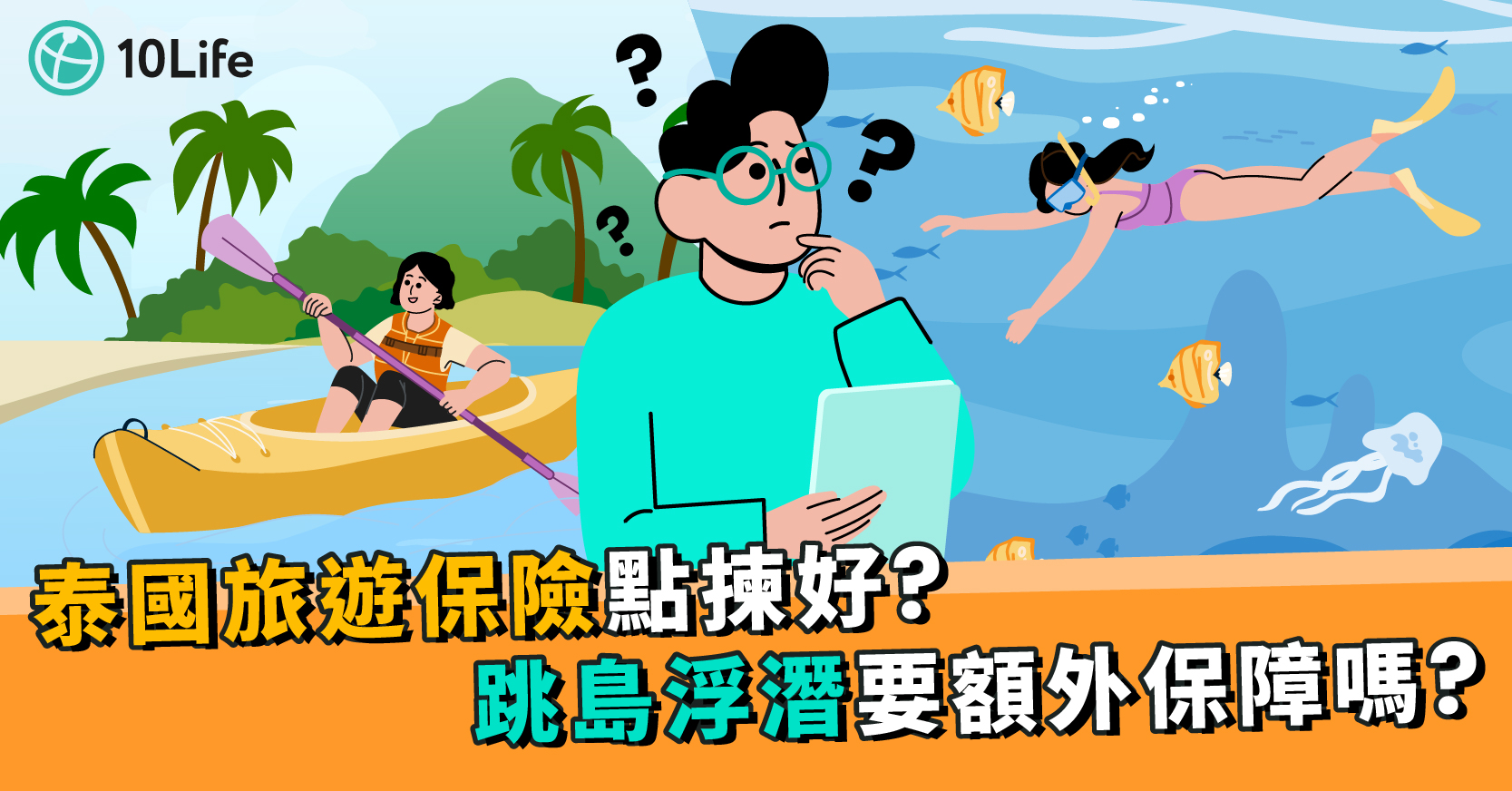
When planning a trip to Thailand, apart from flights and hotels, travel insurance is absolutely essential. As a popular travel destination, Thailand attracts countless Hong Kong travellers, from the bustling streets of Bangkok to the island scenery of Phuket. However, if an accident unfortunately occurs during your trip, especially when taking part in activities such as snorkelling and skydiving, the impact can range from ruining the mood to causing injury; therefore, travel protection should not be overlooked. There are many travel insurance products on the market, each offering different levels of cover. This article will explore in depth how to choose suitable Thailand travel insurance, analyse the cover needs for water activities such as snorkelling, and highlight important considerations for special situations such as self-driving trips and natural disasters, helping you enjoy your journey with peace of mind. Travel insurance is not only reassurance, but also a smart purchase, allowing you to have a fulfilling trip without any worries.
How to choose Thailand travel insurance?
When choosing travel insurance for Thailand, the first priority is the five core areas of cover: medical expenses, personal accident, baggage cover, trip cover and emergency assistance. Medical expense cover is the most critical, as private hospitals in Thailand are expensive; even a routine A&E consultation can easily cost thousands, while a more serious accident could amount to hundreds of thousands.
Unlike scuba diving, snorkelling is usually carried out on the surface or in shallow water, with simple equipment and a low technical barrier; basic swimming ability is sufficient to take part.
Common risks include cramps, sunburn, being carried away from the shore by waves, or panic due to difficulty adjusting to seawater, but most of these situations can be reduced through preventive measures. Travel insurance generally covers snorkelling activities, but the policy wording should still be checked carefully, as some insurers classify any form of diving as a high-risk activity and require additional cover. It is scuba diving that truly requires extra cover, as it involves high-pressure environments, specialist skills and special equipment, making the level of risk significantly higher. Many insurers impose depth limits for scuba diving, and many plans cover recreational diving to a depth of around 30 metres, but the depth limit and whether additional diving insurance is required depend on the insurer. Travellers planning to obtain a diving qualification should read the policy terms carefully to ensure that both the training process and certified diving activities are fully covered, avoiding the need to pay substantial medical expenses out of pocket due to insufficient cover.
Other common high-risk activities in Thailand
White-water rafting on the River Mae Taeng is a signature activity in Chiang Mai, seemingly thrilling but fraught with risks. Rocks, whirlpools and unpredictable currents in the rapids have previously led to capsizing accidents. Although canoeing is calmer, prolonged paddling can easily cause fatigue, and if the canoe overturns, travellers who cannot swim may be put in danger. Speedboat self-drive requires even greater caution: as boat traffic in Thai waters is frequent, inexperienced drivers may lose control and collide with other vessels or coral reefs. Many standard plans exempt or impose special terms for such high-risk activities, and some require the purchase of additional specialist cover for high-risk sports. Before buying, you should confirm whether the policy clearly states the scope of cover, and understand the excess and compensation limits. Before taking part, be sure to attend the safety briefing, wear full protective gear, and avoid participating after drinking alcohol or in adverse weather conditions.
High-altitude activities deliver an unforgettable adrenaline rush, but the level of risk increases accordingly. Skydiving centres in Thailand are mostly located in coastal areas, where wind conditions can change significantly; if landing drifts outside the designated area and collides with obstacles or falls into the sea, it can be extremely dangerous. Paragliding depends heavily on weather conditions, and sudden air currents may cause uncontrolled spinning or a rapid descent. Although bungee jumping is carried out with professional instructors, equipment failure or operational errors may still result in serious injury. These activities are generally regarded as extreme sports, and most standard travel insurance policies do not provide cover, or require a substantial premium surcharge. Some high-risk activity insurance policies may also require the operator to hold international certification, have qualified instructors accompanying the activity, and use approved equipment. Travellers planning to take part in high-altitude activities should purchase insurance at least one week in advance and disclose the specific activity details to the insurer, including the location, height and operator information. At the same time, retain all payment receipts and activity confirmation documents so that evidence can be provided when making a claim, avoiding a rejected claim due to incomplete documentation.
Off-road activities in northern Thailand have become increasingly popular in recent years, but the terrain is rough and accidents may occur. Off-road motorbikes may look simple, but in reality the mountain roads are steep and the surfaces muddy and slippery, so riders may lose control and fall. Off-road buggy activities are usually faster, and vehicles can easily overturn when turning; passengers who are not wearing seatbelts may be thrown out of the vehicle. Gorge exploration involves climbing, wading through water and passing through narrow channels, and slips, falls or falling rocks can all cause serious injury. These land-based adventure activities require particular attention to the coverage scope of “land motor sports” in the policy terms. Some insurers impose additional conditions or premium adjustments for high-risk activities for older travellers, such as those aged 70 or above; the specific age threshold depends on the insurer. Before taking part, you should assess your own physical condition, choose a reputable operator, and confirm that it has public liability insurance. You should also, as far as possible, record the equipment inspection process and the safety briefing session on video, as these recordings can effectively demonstrate that you have exercised reasonable care when making a claim and help reduce the insurer’s challenge of “reckless behaviour”.
Self-drive travel may require an additional purchase of cover
Although self-driving tours in Thailand offer freedom, the potential risks should not be overlooked. Thailand’s local traffic rules are vastly different from those in Hong Kong; motorcyclists often ignore road rules, large vehicles have significant blind spots, and some rural roads are in poor condition, making the risk of accidents much higher than when driving in urban areas. While standard travel insurance typically covers personal accident and medical benefits, it often provides insufficient cover for third-party liability and vehicle damage. Insurance offered by car rental companies usually comes with a high excess and does not cover damage to tyres, the undercarriage or windows. A specialised self-drive tour insurance can fill these gaps, providing comprehensive third-party liability cover (recommended at least HK$1 million), comprehensive vehicle cover and personal injury protection. Before purchasing, it is advisable to compare the policy details of different insurance products, paying particular attention to whether the claims process is straightforward, whether 24-hour roadside assistance is included, and whether towing and substitute vehicle arrangements are provided, as these details are crucial when you encounter difficulties abroad.
Special considerations for Thailand travel insurance
The outbound travel alerts issued by the Security Bureau for different regions in Thailand may affect the scope of cover and eligibility conditions under some travel insurance policies for related incidents. The actual arrangement depends on the individual terms of each insurer. In general, a yellow alert has a relatively limited impact on the basic cover of most products; however, while a red or black alert is in force, some insurers may set limits on, or decline, claims directly related to the relevant event, and may also refuse new applications for cover. Please refer to the “outbound travel alert / known events” clause set out in the policy for details. A more prudent approach is to arrange insurance as early as possible in the initial planning stage of the trip, before the risk has clearly escalated, and to keep up to date with the latest announcements from the Security Bureau and insurers.
When travelling, you should properly keep your flight tickets, hotel bookings and receipts for paid activities, so that if you later need to make a claim due to a travel alert or a sudden incident, they can be used as evidence that you have taken reasonable care, reducing the risk of a claim being rejected due to insufficient information or disputes.
Thailand’s overall earthquake risk is relatively lower than that of many neighbouring regions, but seasonal storms and localised flooding remain common, so cover for natural disasters should not be overlooked. Travel insurance policies usually set clear time limits and “known event” boundaries when dealing with natural disasters: in general, they only cover disasters that first arise after the policy takes effect and were not already widely known at the time of purchase. For storms or floods that have become a “known event”, related itinerary changes are usually excluded from cover; the actual position will be subject to the terms of the individual policy.
The distribution of medical resources in Thailand is highly uneven, which places greater demands on the medical benefit limit under travel insurance, particularly for travellers planning to take part in higher-risk activities or visit outlying islands. International hospitals in major cities such as Bangkok and Chiang Mai have advanced facilities, and many doctors have international or Western training backgrounds, so the overall medical standard is trusted by many overseas visitors. However, charges are also very high; from specialist consultations and imaging tests to hospitalisation and surgery, costs are often calculated in tens of thousands, rather than at the level of ordinary travel outpatient care.
Taking trauma or fracture cases as an example, if surgery, anaesthesia, several days’ hospitalisation and multiple tests are required, the cumulative cost may reach over HK$100,000 or even higher. The actual amount can fluctuate significantly depending on the hospital tier, whether a special room is required, medication and the complexity of the surgery. By contrast, outlying island areas such as Koh Samui and Phi Phi Island mainly rely on relatively basic clinics or small medical centres. In the event of a serious accident or complications, patients often need to be transferred to large hospitals in Phuket or Bangkok for treatment, and such emergency medical transport (including speedboat, ambulance or even helicopter) is itself a considerable expense, further driving up the overall medical cost.
This English version of this article has been generated by machine translation powered by AI. It is provided solely for reference purposes. In the event of any discrepancy or inconsistency between this translation and the original Chinese version, the Chinese version shall prevail.
I’m delighted to be part of 10Life in building a one stop insurance platform.
10Life Product Comparison and 10Life Insurance Ratings are developed by 10Life Financial Limited, an authorised insurance broker company licensed with the Insurance Authority under License Number FB1526. 10Life Product Comparison and 10Life Insurance Ratings are developed for generic customer segments using mathematical calculations based on product information, facts and data, and are not influenced by any partnerships with or fees received from insurance companies. Any information on 10Life Platform ("10Life Information"), including but not limited to Product Comparison, Product Ratings, Blog Articles are intended for general education purpose and reference only. None of the 10Life Information is intended, nor should they be considered or relied upon, as regulated advice, insurance, financial, investment or professional advice, recommendation, approval, endorsement, invitation or solicitation in respect of any insurance, financial or investment products. 10Life Information does not take into account your individual needs. Reading 10Life Information should not be considered as conducting a suitability assessment, and is not sufficient to form the basis of any decisions to purchase any insurance products. You should rely on information authorised by insurance companies, carry out your own research and/or seek independent advice from licensed intermediaries before purchasing any insurance products or making any insurance decisions. While reasonable effort is used when collecting, validating and updating 10Life Information from various channels, none of 10Life Group and its subsidiaries, affiliates, agents, directors, officers and employees will be responsible for any liability, claim or loss arising from or associated with you using 10Life Information. No warranty, representation or guarantee is given by 10Life Group and its subsidiaries on the accuracy, completeness and timeliness of the information. If you have any questions on 10Life Product Comparison and 10Life Insurance Ratings, please email us at enquiries@10life.com




 Talk to 10Life on WeChat
